
Beyond the Borders of Culture
How California Borderland Artists Are Redefining ‘Community’
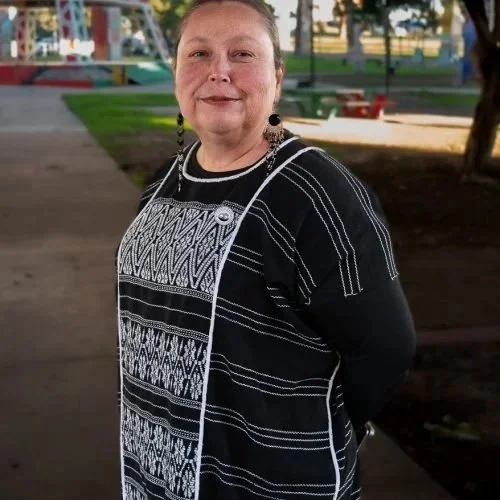
Monica Hernandez, Executive Director at Chicano Park Museum and Cultural Center and San Diego District 1 Arts & Culture Commissioner. Photo Credit: Chicano Park Museum and Cultural Center.
By Lindsay Sopko
Jun. 30, 2026
SAN DIEGO—From the open doors of the Chicano Park Museum, the sound of music and laughter winds its way up neighboring balconies and muraled bridges. Inside, members of San Diego’s Barrio Logan artist community chat excitedly as they take in the art on display–embroidered tableaus of communal living and linocut prints of burning cop cars. Each painstaking detail crafted by members of San Diego’s oldest Mexican-American neighborhood, and curated by the museum’s director: Monica Hernandez.
Though the Chicano Park Museum and Cultural Center is fairly new (founded in 2022), Hernandez’s roots to the community run deep. A native of San Ysidro, the town located at the crossing between the United States and Mexico immediately south of San Diego, she’s been instrumental in shaping artists' communities within the border region–a passion that started as a young girl watching neighborhoods buckle under regional tensions.
“Being from San Ysidro, being in a border town, at a time prior to Operation Gatekeeper, you used to see people getting rallied up, you used to see the border patrol getting beaten up, beating up relatives, friends, community, they didn’t distinguish between the community there and the people that were passing through. And for me as a kid seeing that and living that reality, I was trying to make sense of that.”
In 1994, the U.S. Border Patrol initiated “Operation Gatekeeper,” a border enforcement program introduced by then-U.S. Atty. Gen. Janet Reno under the Clinton administration. The program, which mirrored 1993 “Operation Hold the Line” in El Paso, Texas, aimed to deter undocumented immigration to the U.S. by funneling migrants through remote–and often treacherous–crossing areas, rather than previously used urban corridors.
To accomplish this, the U.S. government began militarizing the Southern Border region of California, to include San Ysidro. Backed by over $1 billion of Congressional funding, Operation Gatekeeper erected walls and expanded detention spaces, opened up interior Border Patrol checkpoints, and increased the number of agents deployed to the area. To this day, the success of Operation Gatekeeper is highly debated among government and community leaders, who argue over the impacts to families, indigenous communities, and wildlife.
“I didn’t understand it,” said Hernandez, “but I knew there was something wrong with it. And that was always a driver in trying to figure out, ‘Well, what can I do about it? How can I change that?’”
For Hernandez, the route to change was through education. After a childhood spent in the borderlands, Hernandez moved to the Bay Area, where she attended University of California Berkeley. Hoping to shed some light on the issues facing her community, she earned a degree in Chicano studies with an interdisciplinary focus in social justice, cultural studies and multimedia; however, her investigation of the criminal justice system left her disappointed and disillusioned.
“This system is corrupt,” she said, “and it’s meant to be working this way.”
This realization, she said, led her down another path: one where art helps shape the community.
“Being out in the Bay and seeing all these other community spaces like La Peña, those were inspirations,” Hernandez explained. “Here in San Diego the closest thing we had was this space called Voz Alta…We didn’t have any cultural spaces back then in the 90s. The communities were a lot more segregated, and we weren’t welcome in spaces like Balboa Park. So after I graduated college, I went back to San Ysidro and connected with a non-profit called Casa Familiar, and they helped us do THE FRONT.”
Opened in 2007, THE FRONT: Arte & Cultura is an art gallery, education space, and venue for community members of both San Ysidro and Tijuana. The artist space hosts regular events and classes, to include free ballet lessons for kids, live music recording sessions, poetry workshops, and more.
“We started building community here through arts and culture,” said Hernandez.
As the success of this community space grew, Hernandez realized she could do more–that is, if she could gain a seat at the table.
“I was with Casa for many years,” said Hernandez, “and then I became involved with the [San Diego County Arts & Culture] Commission, because one of the things I realized was the importance of being at those decision making spaces. Where decisions are being made about how funding is being distributed.”
Today, Hernandez serves as both the Executive Director at Chicano Park Museum and Cultural Center and an Arts & Culture Commissioner representing District 1 of San Diego County. These roles have afforded her the opportunity to work with organizations such as San Diego ART Matters, an advocacy and arts service provider to the region’s nonprofit arts and culture sector. Working alongside her mentor, Felicia Shaw (President of CA for the Arts and Executive Director of San Diego ART Matters), “has been a dream job,” said Hernandez.
This past Tuesday, Hernandez hosted San Diego ART Matters at the Chicano Park Museum and Cultural Center for the fourth event in the In Community series. The countywide initiative, which is sponsored by the Prebys Foundation, aims to showcase regional artists while providing community members and leaders a chance to connect–both personally and professionally.
This week’s event included performances from local artists Nicole McFly and Montezuma Zepeda. After a Kumeyaay Land Acknowledgement by Hernandez, McFly kicked off the event with her original song “Tierra y Libertad,” turning the acoustic melody into an elaborate showcase. Performing under her persona “Tula,” she captivated the crowd with her bold presence and evocative lyrics. The song’s title pays homage to Mexican Revolutionary Emiliana Zapata, who popularized the rally cry for agrarian reform and the redistribution of land to rural and indigenous communities. Her song speaks to the longstanding struggle of borderland communities in the fight for land, resources, and recognition amidst polarized governments and societies.
The song is part of her album Acérquense Niños. Her song “El llanto del migrante,” of the same album, was featured in the Frontera Filmmakers program at the 33rd San Diego Latino Film Festival. The short film and music video was directed and produced by McFly and Max Garcia, and is a testament to her musical journey.
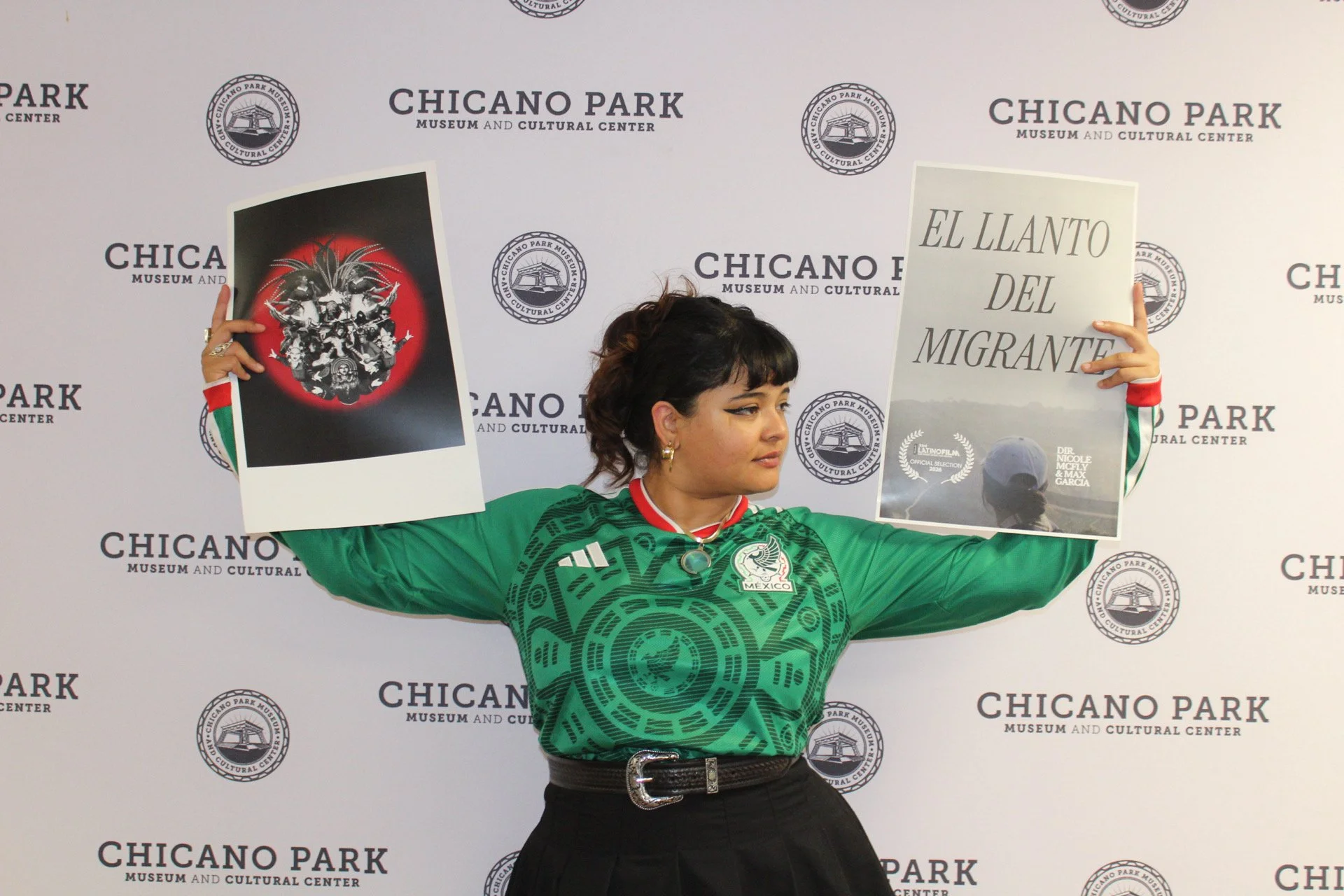
Nicole McFly at the Chicano Park Museum and Culture Center in San Diego, Calif. on Jun. 30, 2026. Photo credit: Lindsay Sopko.
“I started playing at the beach,” said McFly, “I started busking, and I’d be following people and make them laugh, make kids dance…and it was just me and my guitar.” Soon after, she found other musicians through open mic nights who shared the same vision, and she invited them to jam.
“I don’t believe in collaborations,” said McFly, “I believe in ‘let’s hang out! Let’s just play a little bit and see where that leads.’”
This focus on authentic connection is shared by poet Montezuma Zepeda, who bookended the event with his spoken word poems “Cultura,” “Lord of the Flies,” and “If Ghosts were real…” These works challenge what it means to have faith: in religion, in superstitions, in institutions, and in ourselves.
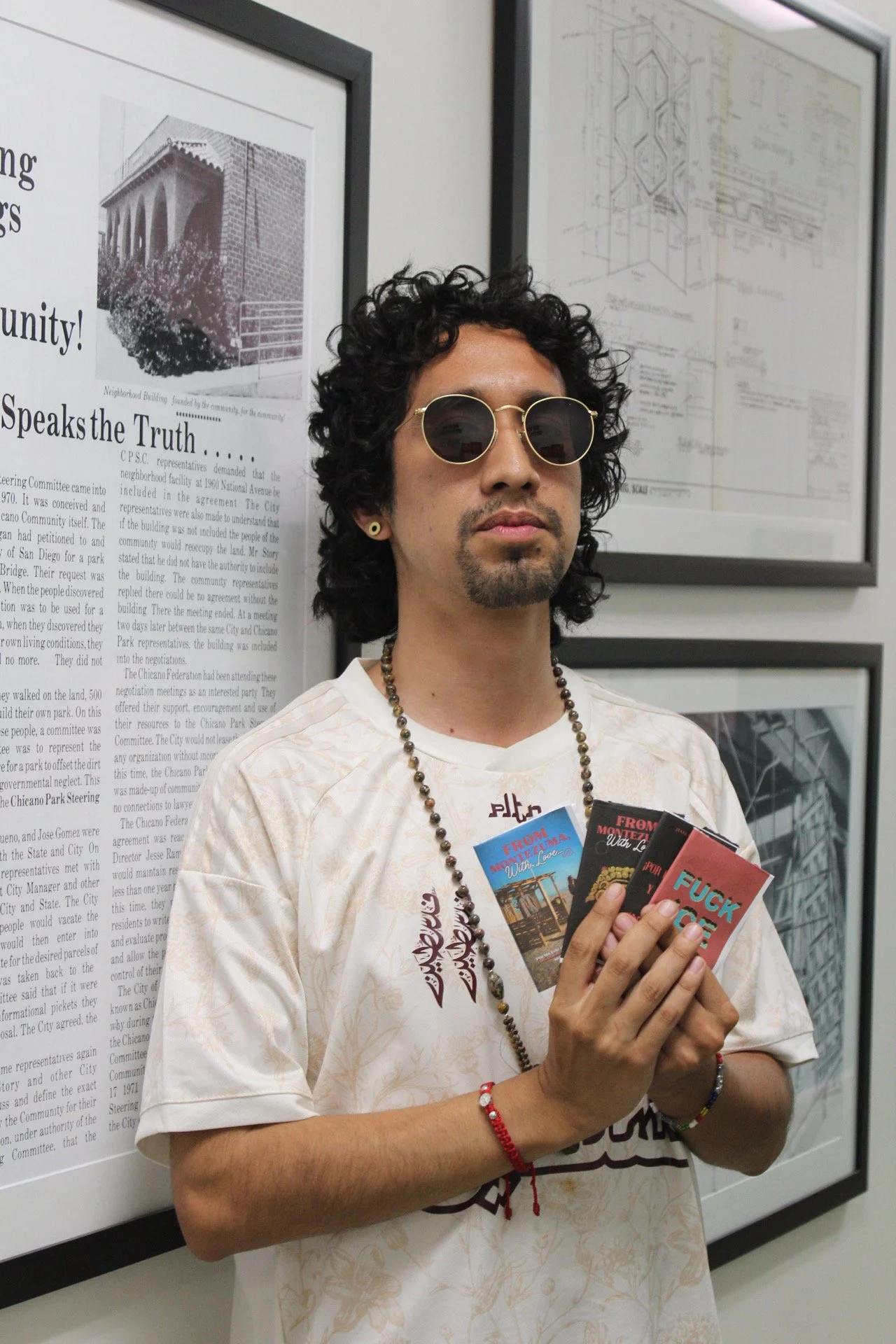
Performing “Lord of the Flies,” Zepeda recited: “A confession Booth of indigenous children / And all of their bodies buried under the missions / All this belief?! / Just to suffer and smile!? / Just to wait until death for a paradise child? / Not for me / Paradise is here on earth.” As he spoke the lines, audience members nodded and snapped their fingers–the only noise over the impassioned words of the poet.
Before his final poem, “Every Household Deserves Paper,” Zepeda addressed the crowd.
“Access to art is important,” Zepeda said, “access to resources is important. And I think this poem encapsulates how I feel about all that.”
When asked about his creative process and how he comes to put pen to paper, Zepeda explained that, for him, “the most important thing is just living and being within community.”
“On a community level, these poems are addressing systemic issues at large. But a lot of my other work addresses my own community directly, because I feel like to move forward in certain systemic issues we still have to be accountable for ourselves and what we do and our complacency for certain things.”
Montezuma Zepeda performs at the Chicano Park Museum and Culture Center in San Diego, Calif. on Jun. 30, 2026. Photo credit: Lindsay Sopko.
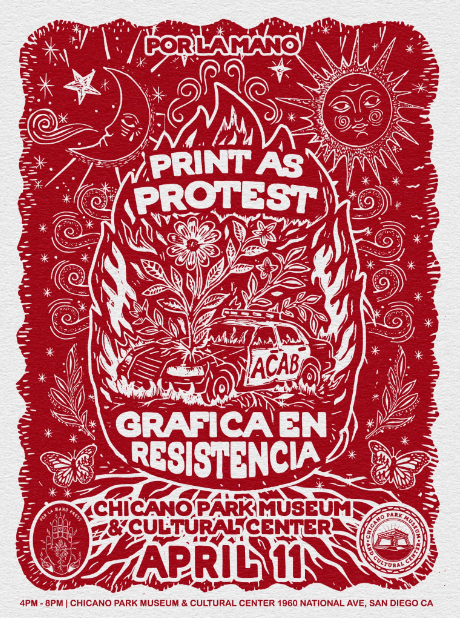
A block-print poster for “ART AS PROTEST” an event and exhibition featured at the Chicano Park Museum and Cultural Center in San Diego, Calif. Photo Credit: Chicano Park Museum and Cultural Center.
This throughline of accountability is reflected in the many exhibits at Chicano Park Museum, such as “PRINT AS PROTEST,” an exhibition that honors gráfica as a living practice of resistance, solidarity, and community storytelling.
The exhibition, which is still on display, is the embodiment of everything Hernandez has worked toward since her time in the Bay Area–a space to redefine her community.
“My heart,” said Hernandez, “was always down here.”